An Accidental Invention – The Evolution of the Color Mauve
*Customer alert: this is going to be a slow amble through history. I hope you find it elucidating.
Mauve. What a blasé sort of word. What is it, anyway? It’s the name of a color. How does one describe the color Mauve? It fits in with the purple family, but it can also drift toward the pinks. My research into this rather bizarre subject has led me to discover that the color didn’t exist before 1856 – weird, huh? To think that with our world of colors today, galore in all hues and tones, that a color hasn’t always been around. But it’s true. Purple existed but not mauve.
Two hundred years ago people lives were drab - as in - lacking in color. One of the reasons for this was a consequence of living in communities where the fuel they burned for factories, rail transportation, and heating their homes was coal. A major source of air pollution, the coal, which had to be heated to extremely high temperatures, released huge amounts of smoke and soot that clung to all surfaces and created the cloying, black smog often depicted in the writings of Charles Dickins and Sir Arthur Conan Doyle.
Considering this track record, the development of the glorious synthetic color “mauve” as a by-product of coal-tar is beyond my strength to resist investigating. Coal-tar is a messy, thick liquid, heavier than water, that forms as a by-product of heating coal to create coke or coal gas. Victorian England had a lot of it around. The River Thames was dangerously polluted with it.
Finding a way to repurpose this disgusting by-product was on a lot of people’s minds. One idea research scientists were exploring was, “Could it be synthesized into quinine?” Seems like kind of a crazy notion, but what the heck. Natural quinine, used to treat malaria, was precious stuff. Harvested from the bark of the tropical cinchona tree in the Andes, there just wasn’t enough of it to be had, especially if Britian wanted to maintain its colonial empires in malaria-infested territories. Creating a substitute for natural quinine had become a critical necessity. So, during the mid-1800s, chemists began earnestly applying themselves to finding a solution.
One of the men devoted to solving this puzzle was German chemist, August Hofmann, who was appointed in 1845 to serve as the director of The Royal College of Chemistry in London. Endorsed by Albert, Prince Consort to Queen Victoria, who was himself a supporter of innovation, Hofmann and his peers recognized that the world was changing and that exciting possibilities existed in the pursuit of the sciences. Chemistry, a booming new field and part of the industrial revolution, was a noble profession. Hofmann’s job was to oversee young research scientists as they hypothesized and experimented with a number of mysteries, including how a yucky residue derived from coal could be synthesized into a life-saving medicine.
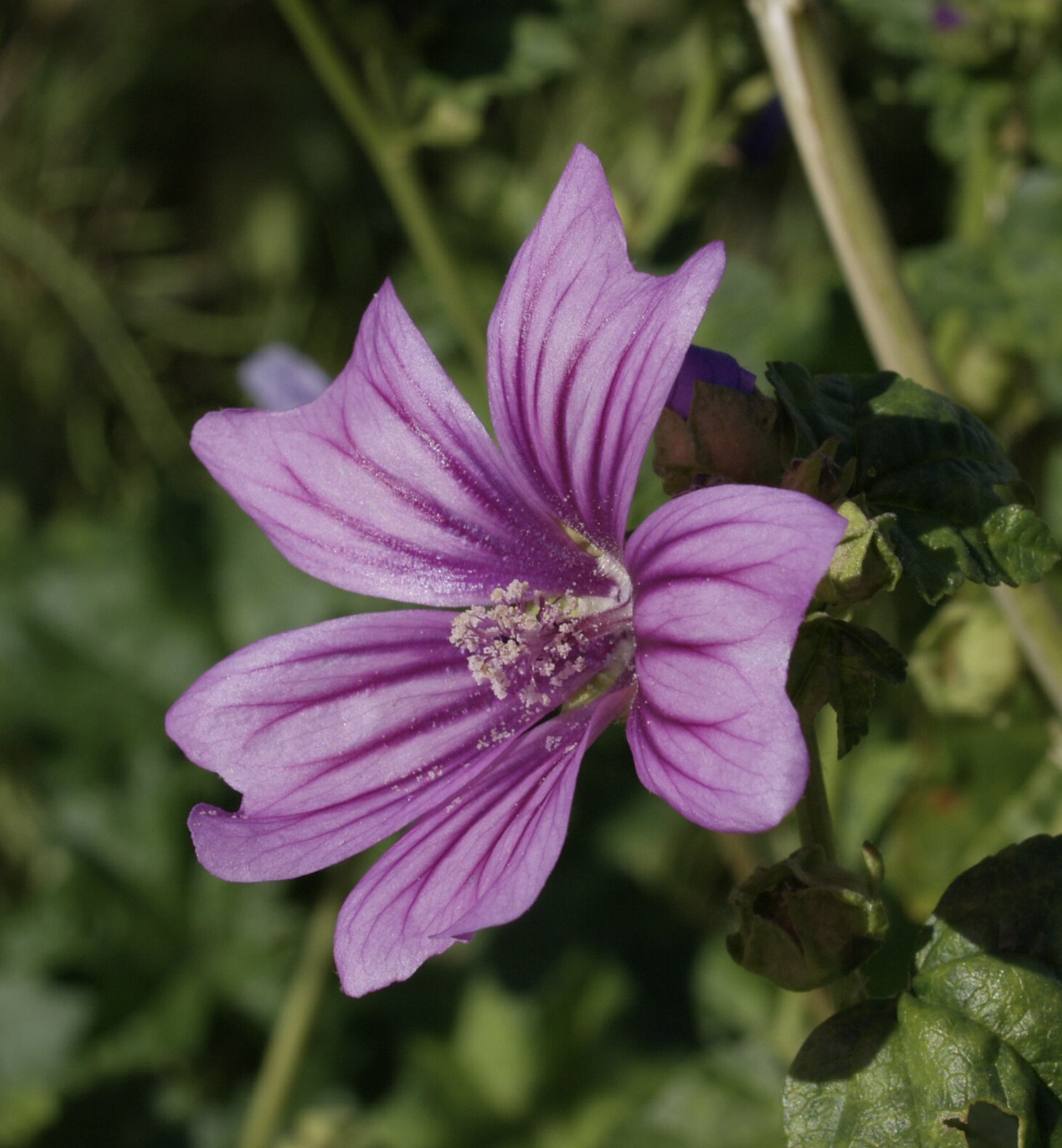
One day in 1856, William Perkin, an energetic and intelligent 18-year-old and member of Hofmann’s cadre of students was left with a compacted clump of useless hardened, black residue at the bottom of his beaker following a series of experiments. Typically, this dud of a result wouldn’t have compelled any more investigation and could have been the end of the story; Perkin could easily have discarded the residue and gone home to dinner. Instead, blessed with an unquenchable curiosity about everything, he kept the lump, returning to it later and distilling it in a mixture of “spirits of wine,” which produced a rich lavender hue similar to the color of the Mallow wildflower. Best of all, it proved itself to be color-fast on silk when he began experimenting with fabrics.
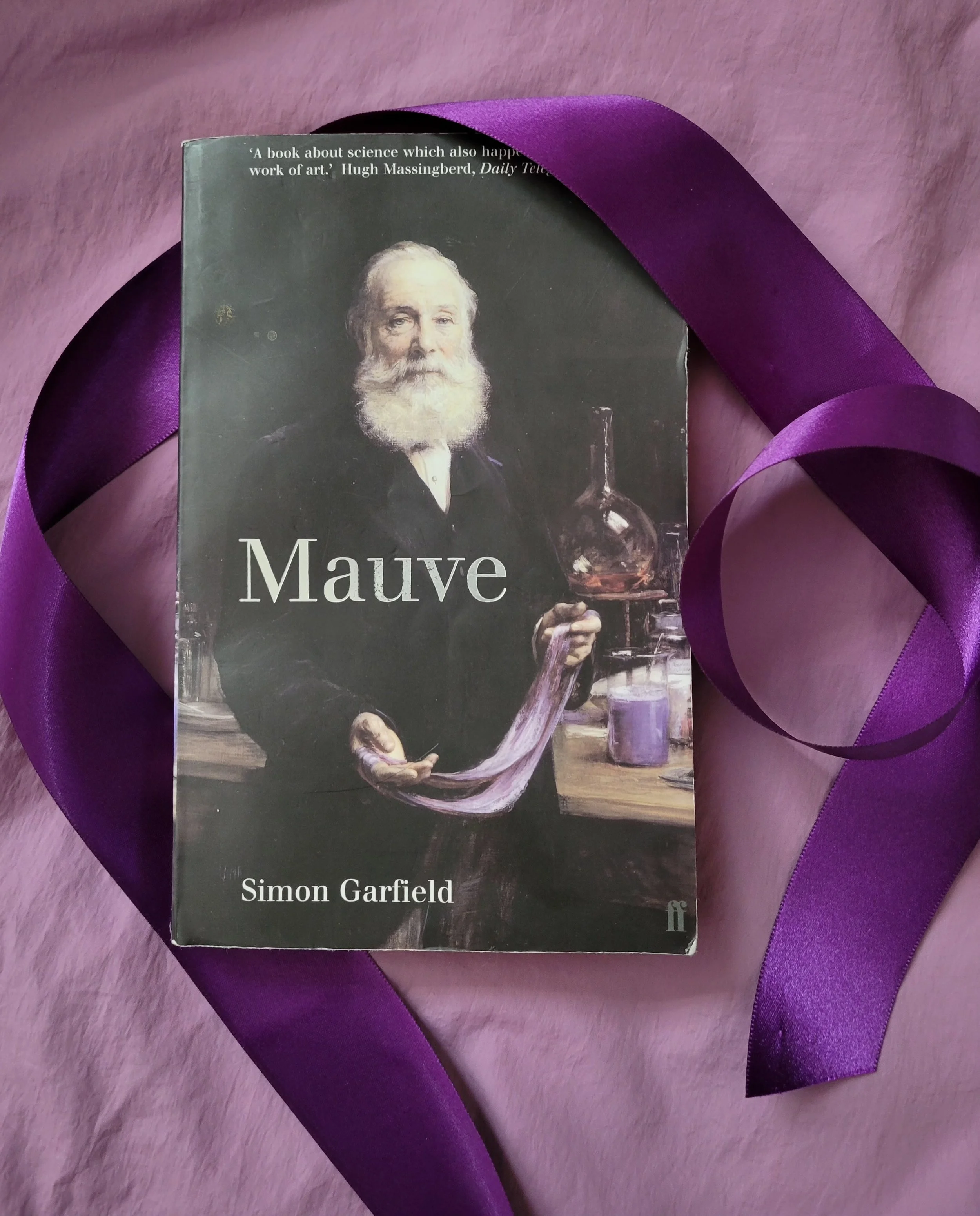
Unexpectedly, instead of quinine, Perkin had accidentally invented a substance that would alter the world of color. His timing could not have been more perfect. He named it Mauvine.
Natural dyes had always been available, but they were expensive, only to be obtained from plants and insects—typically masses of insects—and mollusks. It was a stinky and messy business to extract dye from natural substances. Consequently, the wearing of reds, purples, and blues was relegated to people of status. Now with this accidental invention nearly everyone could afford to jazz up their wardrobes.
Perkin wasn’t unique in discovering a new dye. Other chemists had been playing around with trying to find synthetic dyes using the organic compound, aniline, but they hadn’t quite figured out the process or proportions yet in a reliable, repeatable way. Once Perkin conquered the first half of the mystery, his discovery gave birth to a new industry. It was the event that blew open the door for the development of other synthetic dyes.
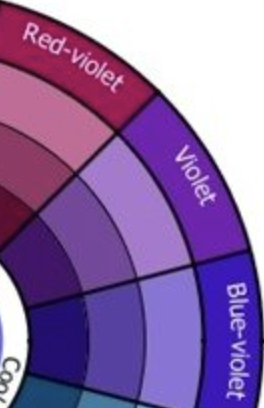
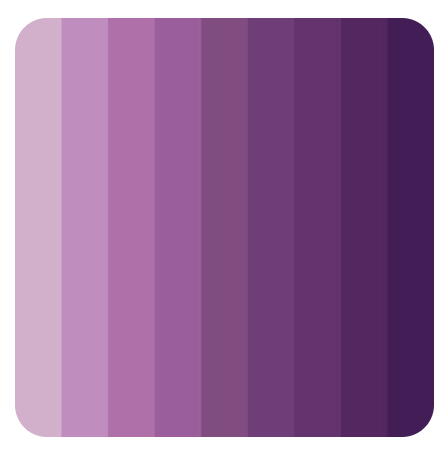
Between 1859 and 1861, Mauvine shortened to Mauve became “the” fashion. Technically, mauve is a pale, dusty/grayish bluish-purple. Of ambivalent character, it is often described as sitting right on the border between pink and purple and can also be a "pink-purple" or "dusky rose-purple.”
The color initially enjoyed tremendous popularity partly because both Queen Victoria and Empress Eugenie of France favored it, and it fit in nicely with the customary black clothing worn during the rigor of months-long mourning demanded by Victorian society. In the 1890s, it started to lose its popularity giving way in the Edwardian era to richer purples and tamer lavenders. By the Art Deco era in the 1920s, it had completely lost its footing, regarded as too “romantic” for the era’s modern and bold aesthetic.
And it stayed a wallflower throughout most of the 20th century until it was demurely revitalized in a poem written by British poet Jenny Joseph in 1961. Titled “Warning,” it’s quite dated now, but the overall sentiments are timeless. Here are the first two lines:
When I am an old woman, I shall wear purple
With a red hat which doesn’t go, and doesn’t suit me.
When I first stumbled on this poem, I was in my late 30s, and I remember being quite annoyed, even a bit angry because purple has always been one of my favorite colors. I didn’t appreciate that it had been relegated to old age. Why should I have to wait until I’m a certain age before I get to wear it legitimately? However, upon further examination, I’ve come to learn that the poem’s message actually celebrates aging with freedom as stated a few lines later:
I shall go out in my slippers in the rain
And pick the flowers in other people’s gardens
And learn to spit.
While not exactly throwing non-conformity completely to the wind, the poet is instead encouraging the reader to loosen one’s grip on fulfilling societal expectations by remembering to live for oneself—to play, have fun, find the humor in life, rebel a little bit, and behave authentically with an occasional unapologetic attitude, even if it’s merely expressed by wearing clashing colors. (And maybe spitting . . . )
The color again enjoyed a bit of a rebirth with the publication of “The Color Purple” by novelist Alice Walker, winner of the Pulitzer Prize in 1982. This time though, the color, a veritable character itself, casts a pall over the heavily themed tale about the abuse and poverty suffered by an African American woman in the racist south that existed in the early 1900s.
I can’t close out this meander through the history of Mauve without addressing the color’s place in relevance to Crayola Crayons or rather - its absence, which was its status for quite a long time. Of course, back in beginning, when the Crayola Crayon Factory opened its doors in 1903, the company concentrated on developing the primary and secondary colors of the color wheel.
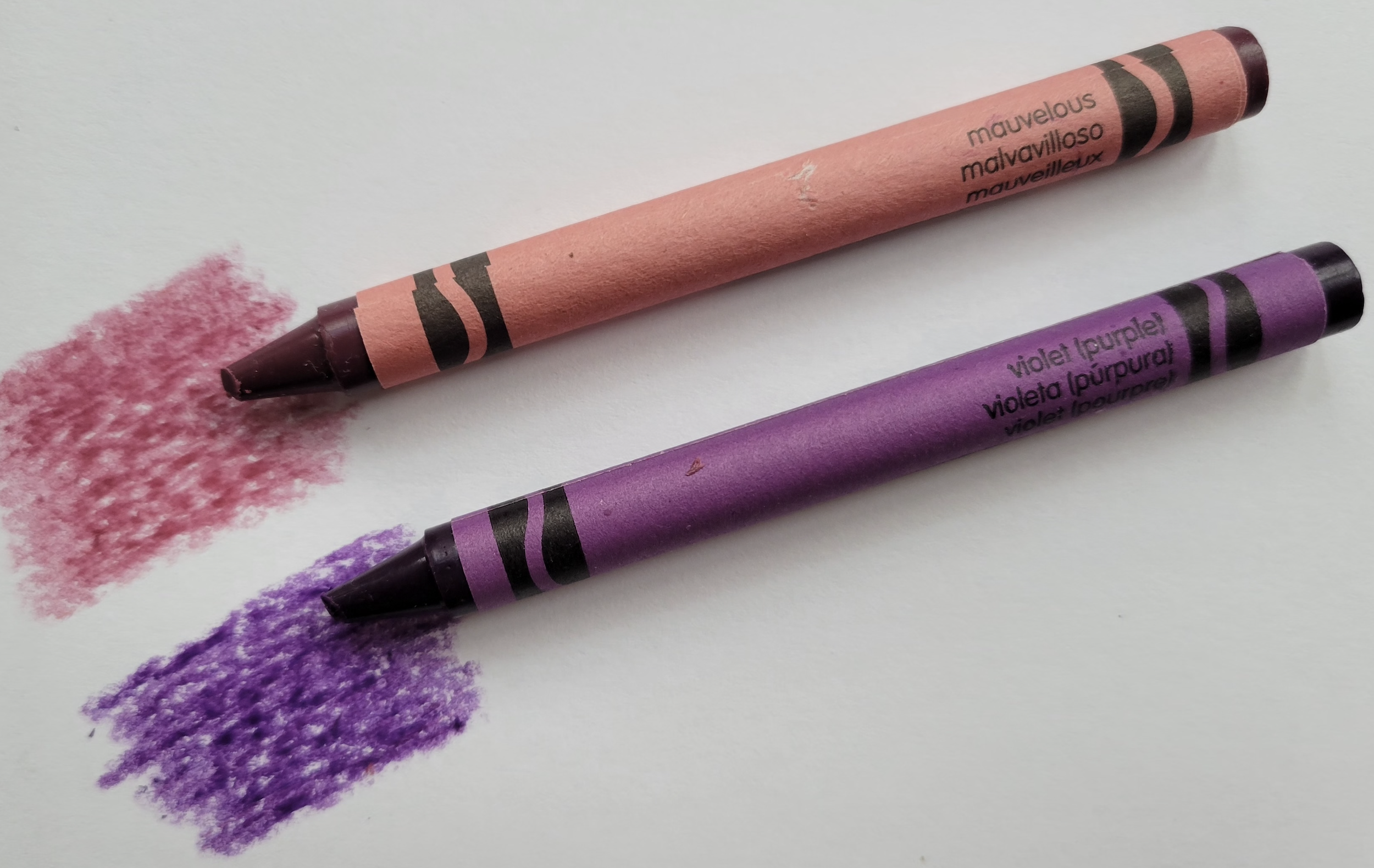
Tertiary colors were more slowly incorporated into Crayola’s boxes although Violet has enjoyed the honor of being the core purple hue since 1903. So, while having already been around for nearly 123 years, the company strangely didn’t create a mauve-colored crayon until 1993. It was one of the 16 new colors launched to celebrate Crayola’s 90th birthday celebration and part of the contest designed to “Name the New Colors.” The Mauvelous name—a blend of mauve and marvelous—was proposed by Susan Rissover of Cincinnati, Ohio. I am completely convinced she was inspired by stand-up comedian, Billy Crystal, and his impersonation of the suave “Latin Lover,” Fernando Lamas, on SNL in the 1980s. Remember? “You look (stretch it out) mahvelous, darling.”
Although Crayola’s crayon, in my opinion, missed the mark. Crayola’s Mauve hugs the pinks and isn’t even a fun pink. It’s deceptively red, but that could be because it’s wrapped in reddish paper that persistently tricks my eye.
Regardless, it is not anywhere near the purple family, barely aligning with the color Perkin isolated in 1856 that reminded him of the lilac-colored Mallow wildflower. The happy news is that among the over 400 colors have been created in the past 123 years with a certain percentage having been forced into retirement, Mauvelous has remained a consistent player in the collection for 33 years.
So, mauve has waxed and waned over the years in the course of its diverse history precisely because it is that kind of color; while not unique in its effects upon the human psyche since all colors affect moods and emotions, purple and its shades are special.
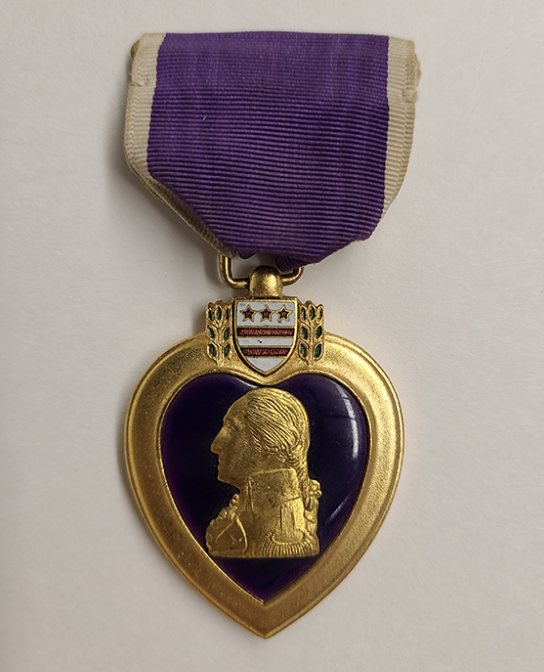
For centuries it has been associated with royalty and luxury, denoting an aura of splendor. While it can be heavy, melancholia-producing and for some a precursor to depression, it is often associated with feelings of spirituality, creativity, and wisdom. It can be calming and for some individuals, provides a segue into meaningful self-examination. It’s a favorite color of children and is used by the US military to commend bravery.
Today, in the 21st century, the color purple is everywhere, in all its tint, tones, and shades. Clothing, home furnishings and interiors, even automotive pigments all rejoice in this remarkable and complex color. And to think, its availability to us is all due to that 18-year-old who refused to give up on a black chunk of coal-tar.