I’ve had the great good fortune to see a lot of live theater in my lifetime—community theater, summer stock, and Broadway shows both on and off—fabulous productions created by playwrights, and brought to life by set designers, composers, and talented actors. I don't think I’ve seen a play I haven’t enjoyed. But by far, my heart’s favorite is the musical MAN OF LA MANCHA. The first time I saw this play was in a quaint, barnlike theater with ancient wooden seats, walls of rough-hewn planks that the evening twilight spied between, and screenless windows flanked with shutters. Flies buzzed around the stage lights while the small ensemble tuned their instruments. And when that music swelled to the rafters, enchantment prevailed. I was instantly transported to Spain of the1600s and drawn-in to the romance, the heartache, the pathos.
Cleverly conceived and written in 1965 by Dale Wasserman, it is a play within a play that tells the story of Spanish poet, playwright, and novelist, Miguel de Cervantes, who is awaiting trial in a prison during the Spanish Inquisition. While Wasserman’s play is completely fictional, Cervantes did indeed live during those tumultuous times of unrest, when poverty abounded, dueling was the way arguments were settled, debtors’ prisons existed for those who couldn’t pay their bills, and diseases of all kinds were rampant.
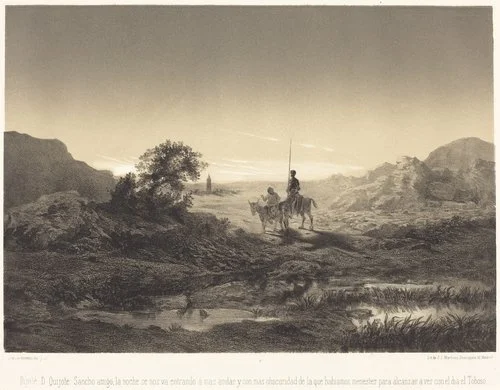
As a young man, Cervantes became a soldier and joined the Holy League—working for the Catholic Church, these ranks were dedicated to annihilating Muslims. After being severely wounded during a battle in the Mediterranean that resulted in him losing the function of his left arm, he managed to eventually return to service but was soon invalided home. Before he could make his way back to Spain, however, the ship he was a passenger on was overrun by pirates who captured him and held him for ransom. When he finally did make it home five years later, he worked various governmental jobs, but life was precarious and harsh and it was only as a much older man that he achieved financial security. As a writer, he is best remembered for his iconic character, Don Quixote, who with his faithful manservant, Sancho, pledges himself to restore the age of chivalry by battling all evil and righting all wrongs. The images below are by the incomparable French artist, Gustave Doré.

Wasserman’s creative vision was to have Cervantes embody his character, certain that the two were one and the same. The play begins when Cervantes, who has offended the Catholic Church and is thrown into a dungeon-like prison, finds himself amidst fellow prisoners who, despairing and ruthless, have designed their own rules for their closed society, which includes grilling each new arrival and if they can, robbing him of his possessions. In Cervantes case, his most precious possession is his manuscript about Don Quixote, the persona adopted by a deranged, country gentleman named Alonzo Quijana whose grip on reality is blurred by his obsession to bring back the age of knights and their code of chivalry and honor.
Anxious to save the manuscript, Cervantes convinces his fellow inmates to let him enact the novel, which he does with the help of his manservant who is transformed into Sancho. He even conscripts his cellmates to take supporting roles.
The play is full of tension and anger, disbelief and mockery, but before realizing it, theater and prison audience alike, become emotionally invested in Quixote’s childlike perspective and naiveté. Declaring himself to be a knight-errant, they find themselves rooting for him as he battles windmills, dons a shaving basin that he calls the Helmet of Mambrino, and pledges his devotion to his “lady” Aldonza—a serving girl and part-time prostitute who is all too cognizant of life’s brutality. Not taken in by Quixote’s idealism after he renames her “Dulcinea,” she grows angry with his attempt to idolize her, rejecting his vision for a better world when his refuses to see her as she truly is. Following the romantic’s creed, defined as “one whose conduct is guided more by the image of perfection than by the real world,” Quixote persuades her with his soaring, heartrending pronouncement:
To dream the impossible dream
To fight the unbeatable foe
To bear with unbearable sorrow
To run where the brave dare not go,
To right the unrightable wrong
To love pure and chaste from afar
To try when your arms are too weary
To reach the unreachable star,
This is my quest, to follow that star
No matter how hopeless, no matter how far
To fight for the right
Without question or pause
To be willing to march
Into hell for a heavenly cause . . .
A heavenly cause—something Aldonza has never had the luxury to entertain. And despite being subsequently taunted and then raped by a group of muleteers, something in Quixote’s passion touches her soul and for the first time in her life, her perspective expands; she sees life from a different vantage point and realizes that striving to live an elevated life can be glorious—that dreaming and hoping drive the pursuit of nobler quests and elevate humans above their earthly bondage.
The prison play ends with Don Quixote (aka Quijana) being returned to his family home where he dies. Both audiences are left to witness his agony at not being able to fulfill his vision of a virtuous life. His striving for enlightenment is heard by one person, however: inspired, Aldonza’s heart has been impacted by Quixote, and she is emboldened to carry his message forward—she becomes his “Dulcinea.”
Cervantes’ fellow prisoners have also been moved by his story of Don Quixote and let him keep his manuscript. The theater audience holds its breath as the prison audience sings the Impossible Dream while Cervantes is escorted from the dungeon to his trial. Both audiences are left to wonder if the inquisitors set him free or sentence him to death.
The telling of this dramatic story is augmented by melodies that are so evocative they figuratively cast a spell and transport the audience to another world. Composed by Mitchell Leigh with lyrics written by Joe Darion, these two artists collaborate on a score that produces an emotional, visceral response. For me, the music is deeply moving, but it’s beyond my ability to explain why so I had to go to the professionals. I am told the reasons I respond to this music the way I do has partly to do with its distinct musical elements starting with its “tempo di bolero” – a rhythm that is the foundation of the score. Flavored by its distinct Spanish-inflected style and folk instruments, the music is anthem-like with time signatures that gives it a “hypnotic pulse.” The orchestration is so rich that it surprised me to learn there are no strings (violins or cellos) except for a double bass, and the sound is achieved, instead, by flamenco guitars, percussion instruments like castanets, and brass and woodwinds. Described as “raw energy” the music segues between the harsh and the melodious. The lyrics, while mostly serious, do give Sancho a few comedic lines, which help lighten the ugliness of the prison and Quixote’s internal plight.
The headliner, TO DREAM THE IMPOSSIBLE DREAM is iconic in its melody as well as its message. It begins slowly and softly, and is often referred to as “prayerlike,” growing in volume as its message becomes more earnest and inspirational . . .
And I know if I'll only be true
To this glorious quest
That my heart will lay peaceful and calm
When I'm laid to my rest,
And the world will be better for this That one man scorned and covered with scars
Still strove with his last ounce of courage
To fight the unbeatable foe
To reach the unreachable star.
Sung by the idealistic Quixote, it is his vow to pursue his quest against all odds, encouraging all who hear it to keep striving for the noble, the righteous, the good, the impossible. And when Aldonza asks him what a quest is he tells her it is the greatest thing a man can do with his life.
So, imagine my surprise when my research uncovered that Cervantes wrote Don Quixote as caustic satire. Despite his own reverence for idealism, Cervantes was mocking the idea of chivalry and its accompanying sentimentality that permeated his culture in the 1600s. The idea of chivalry had morphed from one of the highest expressions of Christian asceticism to a credo of shallow mawkishness.
The very premise of the book is that Quixote goes insane from obsessively reading too much of the kind of literature that featured knights and their pursuits of living a noble life, giving their whole being to hopeless causes, swearing allegiance to their “lady”—even dying honorably for her. These were the writings that glamorized idealism over the cynical reality that was all too evident in the 17th century. Cervantes deliberately made his character a ridiculous parody in order to scorn the attitudes of the day by calling out any romanticized deference to idealism and wanton dreaming. I was heartbroken! I had boughten into his world completely.
But in time the laugh turned out to be on him; what actually happened is Cervantes’ novel reawakened a desire in people’s hearts who recognized the import and power of holding onto an "impossible dream" in a cruel world. His focus inadvertently reinforced the philosophy that “only by attempting the ridiculous may the impossible be achieved.”
Considering what seems to me his defeatist attitude, a further cosmic trick was played on him, though he wasn’t alive to witness it, when writers like Lord Byron, Percy Bysshe Shelley, and John Keats were inspired to revive themes of chivalry a couple of centuries later.
I think the reason these stories have always spoken to us is because they contain an inherent universality. Endowed with personalities capable of so much contradiction, we know we can be better than even our best selves. Don Quixote and his onstage representation in Man of La Mancha are expressions of the deep desire of the human spirit to rise above the confines of this mundane existence, to shake off complacency, to live our lives with honor and truthfulness.
Lastly, I think the message of Cervantes and his dreamer, Don Quixote, is to dream big—don’t do it by halves—dream the biggest dream you can possibly dream. It’s in the striving against all odds that gives the dream its value, not necessarily the achieving of it. How can the human heart not respond to this challenge?
If you’re interested in reading more about the stage play, here is an article by New Line Theatre’s artistic director, Scott Miller.